
Design Guide
Choosing Countertops to Pair With Your Cabinets
Quartz, granite, marble, or wood: here's how to pair a countertop with your cabinets so the kitchen looks planned instead of pieced together.
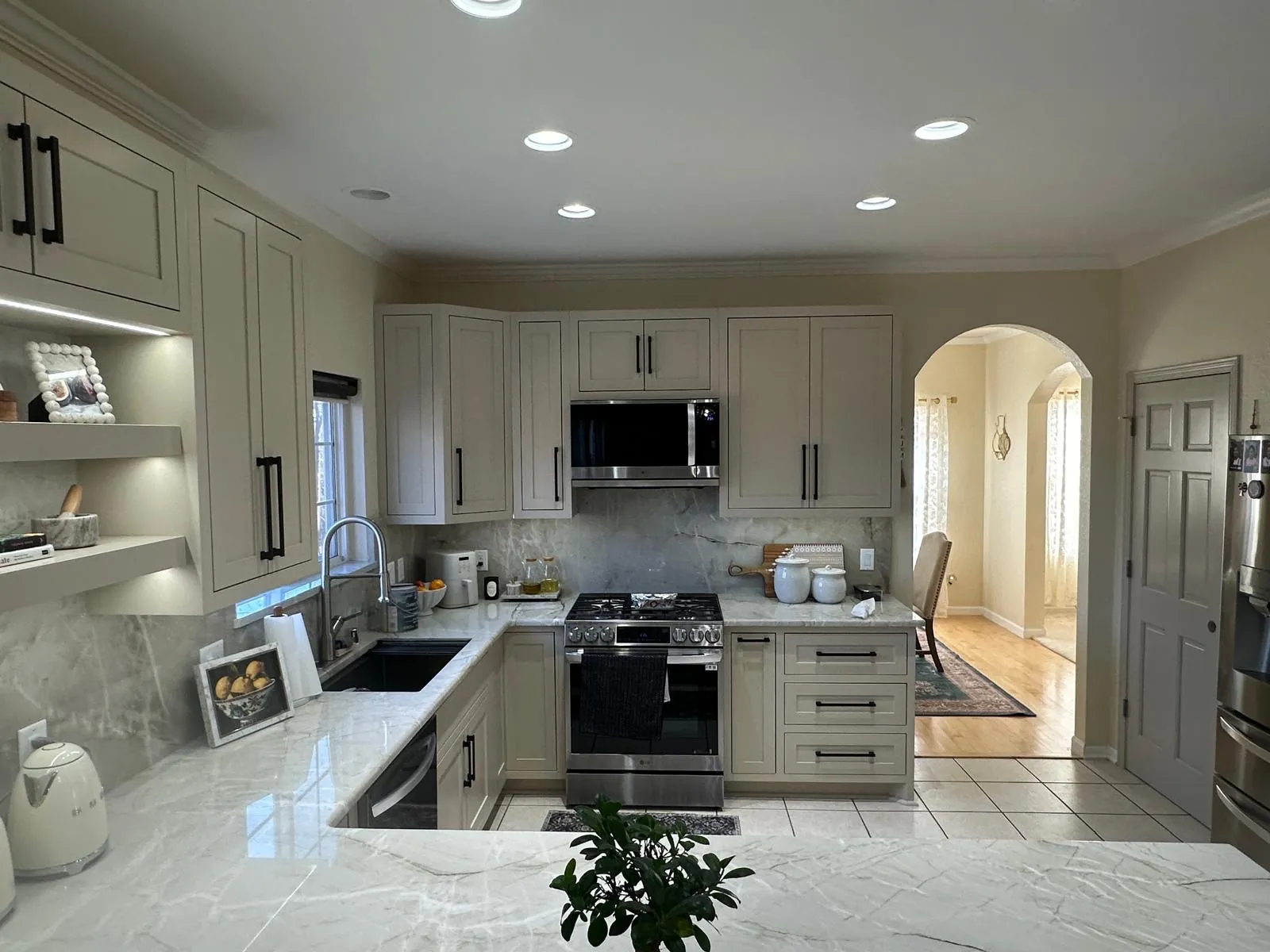
Your cabinets set the tone for a kitchen, but the countertop is what people actually touch and look at every day. Pick the two together and the room feels finished. Pick cabinets first and treat the countertop as an afterthought, and it usually shows. Below are the main countertop options, how each one holds up in daily use, and some pairing logic to keep colors and finishes working with each other instead of against each other.
The main countertop materials, in plain terms
There's no single best countertop. There's a best countertop for how you cook, how much upkeep you're willing to do, and the look you want. Here's how the common options stack up.
Quartz
Quartz is engineered stone, quartz particles bound with resin, so the color and pattern stay consistent from slab to slab. It's non-porous, which means it resists staining without sealing, and it holds up to daily kitchen use without much fuss. If you want a clean, predictable look and don't want to think about maintenance, quartz is usually the easiest to live with.
Granite
Granite is a natural stone, quarried and cut, so every slab has its own movement. No two granite counters look exactly alike. It's hard and heat-resistant, but being a natural stone it's porous and needs sealing every so often to keep stains out. Homeowners who want a one-of-a-kind stone look usually end up here.
Marble
Marble is the classic luxury pick: soft veining, a cool surface, a look you won't get from anything else. It's also the most delicate of the common options. It's softer than granite or quartz, porous, and it can etch or stain if acidic liquids like wine, citrus, or vinegar sit on it too long. Marble suits homeowners who love the look and don't mind babying it, or who'd rather use it on a bar or island than the main prep surface.
Butcher block / wood
Wood countertops bring a warmth that stone and quartz just can't match. They fit naturally in rustic, farmhouse, or transitional kitchens, and once properly sealed they double as a real cutting surface. The tradeoff is upkeep: wood needs periodic oiling or resealing, and it's more sensitive to standing water than the alternatives.
Material costs for any of these vary widely by slab quality, edge profile, and how complicated the installation is. Rather than guess, we'll walk through your specific kitchen with you and get you real numbers.
How to actually pair a countertop with your cabinets
Once you know what a material does, the next question is how it should look next to your cabinet color. A few rules of thumb that tend to hold up:
Light cabinets, contrasting or veined counter
White or light cabinetry is a great backdrop for a countertop with some personality. A veined marble or a quartz with strong movement can become the centerpiece of the room. If your cabinets are already quiet, let the counter do the talking.
Dark cabinets, lighter counter
Dark cabinetry, navy, charcoal, espresso, tends to read best when it's balanced by a lighter countertop. A pale quartz or a light granite keeps the kitchen from feeling heavy and bounces more light around the room, which matters if the kitchen doesn't get much natural light to begin with.
Two-tone kitchens: let the counter be the tie-breaker
Mixing cabinet colors, say a painted island against stained perimeter cabinets, means the countertop is what ties the two together. Running the same countertop across both usually reads more cohesive than treating the island as a separate material altogether.
Match your undertones, not just your colors
This is the detail that trips people up. Warm wood cabinets in oak, walnut, or cherry tones generally pair best with countertops that carry warm undertones: beige, cream, or gold-flecked stone. Cool gray or white cabinets pair best with cool-toned counters like icy whites, blue-gray veining, or charcoal flecks. Pair a warm wood with a cold, blue-gray quartz and the kitchen can feel slightly off, even if you can't put your finger on why.
Don't forget the backsplash
The backsplash bridges your counter and your cabinets, so it should pick up a color or tone from one or both rather than introduce something new. Simple rule: if your countertop has a strong pattern, keep the backsplash quieter. If the countertop is a solid, quiet color, the backsplash is a good place to add some texture.
This all goes smoother when the cabinetry and the countertop get decided at the same table, not weeks apart as separate decisions. That's how we approach every custom kitchen project: we build the cabinetry and coordinate with you on the countertop, door style, and hardware so the finishes, undertones, and edge details work together instead of landing as a pile of unrelated purchases. If you haven't settled on a cabinet finish yet, our guide to cabinet materials & finishes is worth a read before you go shopping for stone.
The best way to see how a specific countertop will look against your cabinet choice is to bring both into the same room. Reach out and we'll help you land on a combination that feels intentional from day one.
Frequently asked questions
What countertop goes best with white cabinets?
White cabinets pair well with almost anything, which is exactly why they're so popular, but the best results usually come from adding contrast or texture rather than matching white-on-white. A veined marble or marble-look quartz, a warm beige granite, or a deep charcoal counter can all work, depending on whether you want the kitchen to feel classic, warm, or bold. Pick an undertone, warm or cool, that matches your flooring and hardware. Don't just assume white cabinets mean anything goes.
What is the most low-maintenance countertop?
Quartz is generally the lowest-maintenance option. Because it's engineered and non-porous, it doesn't need sealing and resists staining better than natural stone or wood. Granite is close behind but needs sealing every so often. Marble and wood both look great but need more careful care: marble is prone to etching from acidic foods, and wood needs regular oiling to stay protected.
Should countertops match or contrast the cabinets?
Contrast almost always looks more intentional than an exact match. A countertop that's noticeably lighter or darker than the cabinets, with a coordinating undertone, adds depth and lets both surfaces stand out. A near-identical match can flatten the kitchen and make it hard to tell where the cabinetry ends and the counter begins.
Let's talk
Colors that work together.
We'll help coordinate cabinetry, counters, and hardware into one cohesive look. Free consultation.