
Design Guide
9 Kitchen Cabinet Door Styles Explained (Shaker, Slab, Inset & More)
The door style sets the whole tone of a kitchen. Here's how the most popular ones look, and which suits your home.
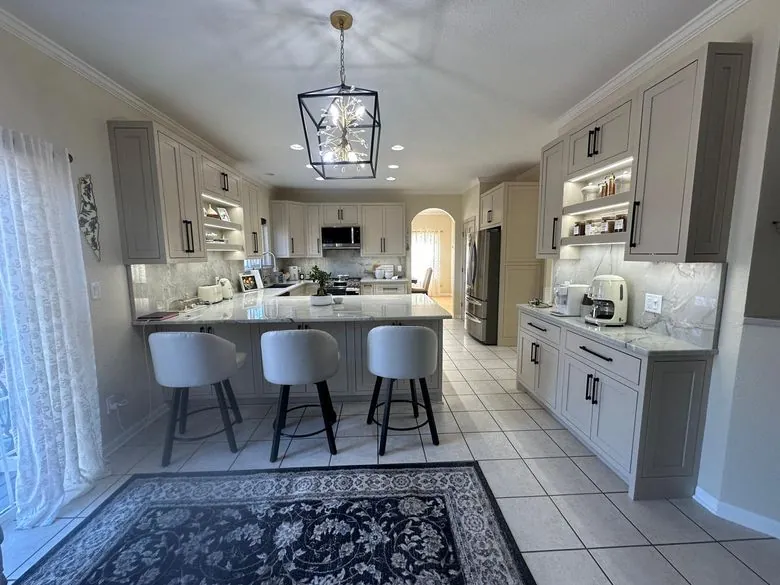
Walk into any kitchen and the first thing you notice isn't the countertop or the hardware. It's the cabinet doors. They cover more surface area than anything else in the room, so the door style you pick does most of the work in setting the tone: clean and modern, warm and traditional, or somewhere in between.
There's no single "best" door style. The right one depends on your home's architecture, how you use the kitchen, and what you find yourself drawn to when you're flipping through photos. Below are nine styles we build regularly, explained in plain terms so you can walk into your custom kitchen consultation already speaking the language.
1. Shaker
A five-piece frame with a flat recessed center panel. Simple and symmetrical, and it adapts to almost anything. It looks at home in a farmhouse kitchen or a sleek contemporary one, depending on the finish and hardware around it. It's the style we build most often. It ages well and doesn't feel trendy five years later.
2. Flat / Slab
One continuous flat surface, no frame or panel detail at all. This is the door of choice for modern and minimalist kitchens, especially paired with handleless or push-to-open hardware. All the visual weight lands on the wood grain or finish, so material choice matters even more here.
3. Raised Panel
A center panel milled to sit higher than the surrounding frame, often with decorative edge profiles. This is the classic, formal, traditional-kitchen door, with furniture-grade detail. It suits homes with more ornate trim work and crown molding elsewhere.
4. Beaded
A Shaker-style frame with a small decorative groove, called a bead, milled along the inside edge of the frame. It's a subtle upgrade. Most people notice something feels more custom without being able to say exactly why. Common in New England-inspired and transitional kitchens.
5. Inset
Technically a construction style rather than a panel style, but it changes the whole look. Inset doors sit flush inside the cabinet frame instead of overlaying it, with a small reveal around each door, similar to a well-built piece of furniture. It reads as high-craft and traditional. Because it demands tighter tolerances, it's worth discussing early with your builder.
6. Glass-Front
A frame, often Shaker or beaded, with glass instead of a solid panel, used to break up a run of cabinets or show off dishware. Clear, seeded, reeded, and frosted glass all read differently. Clear feels open and modern; seeded and reeded feel more traditional and forgiving of what's stored behind them.
7. Louvered
Angled horizontal slats instead of a solid or glass panel, most often used for ventilation on an appliance panel or a laundry/pantry door rather than a full run of kitchen cabinets. It brings texture and a slightly coastal or vintage feel when used intentionally.
8. Applied Molding
A flat or Shaker door dressed up with a separate decorative molding attached to the panel face, often stepped or layered. This is how you get an heirloom, old-world look without going full raised-panel. It shows up a lot in larger, more formal kitchens and butler's pantries.
9. Two-Tone
Not a door profile but a design approach: pairing two different finishes in the same kitchen, most commonly a darker or more saturated tone on the island with a lighter tone on the perimeter. It works with almost any door style above and is one of the easiest ways to make a kitchen feel current without going stark white or stark modern.
Overlay: the detail that changes the look (and the cost)
Door style is only half the picture. How the door sits relative to the cabinet box, the overlay, changes both the look and often the budget.
- Full overlay — doors nearly cover the entire cabinet frame, leaving a thin, consistent reveal between doors. This is the standard for most modern and transitional kitchens today.
- Partial overlay — doors cover less of the frame, leaving more of the cabinet box visible between them. Common in older, more traditional builds.
- Inset — as described above, doors sit flush inside the frame. It's the most labor-intensive to build correctly, which is why it typically sits at the higher end of the cost range.
As a broad industry range, cabinetry cost varies widely by door style, overlay, wood species, and finish. Inset and heavily detailed applied-molding doors trend toward the higher end, while Shaker and flat-panel full-overlay trend more moderate. The only way to know what your specific kitchen will cost is a free custom quote, since every project is different.
How to choose
A useful shortcut: think about the architecture and finishes already in your home.
- Modern homes tend to pair well with flat/slab doors, full overlay, and minimal hardware.
- Transitional homes — the most common request we get — usually land on Shaker or beaded doors with full overlay, sometimes in two-tone.
- Traditional homes lean toward raised panel, applied molding, or inset construction, often with glass-front accents.
None of these are hard rules. Plenty of modern kitchens use Shaker doors, and plenty of traditional homes go two-tone. The best way to get a feel for what fits your space is to see these styles built out in real rooms. Browse our lookbook for examples, and once you've got a direction in mind, read up on cabinet materials and finishes to round out the picture before your consultation.
Frequently asked questions
What is the most popular cabinet door style?
Shaker is by far the most requested style we build. Its clean, symmetrical frame-and-panel look works in modern, transitional, and traditional kitchens alike, which is part of why it's stayed popular for decades instead of falling out of fashion.
What's the best door style for a modern kitchen?
Flat or slab doors are the go-to for modern kitchens, especially with full overlay construction and minimal or handleless hardware. Shaker doors in a matte finish can also read modern when paired with simple hardware and a two-tone palette.
Which door style is best for resale value?
Shaker doors with full overlay are generally considered the safest, broadest-appeal choice for resale, since they read well across design tastes and don't feel dated quickly. Resale value depends on far more than door style, though — quality of build, materials, and layout all matter. A free consultation is the best way to talk through what makes sense for your home and goals.
Let's talk
Found a style you love?
We build every door style shown here. Let's design your kitchen around the one that's you.